
In This Article
Landing at Ben Gurion with your regular carrier still active can be an expensive convenience. Israel roaming costs often look manageable in a carrier app, then grow quickly once maps, ride apps, photo backups, video calls, and background updates start using data. The safest approach is to know how your carrier bills international use before departure and decide whether a prepaid local eSIM is a better fit for your trip.
What Drives Israel Roaming Costs?
Roaming means your home mobile carrier provides service through a partner network in Israel. You keep your usual number and phone settings, but the billing rules come from your carrier at home - not from the Israeli network your phone happens to connect to.
Most travelers encounter one of two pricing models. The first is a daily international pass: you pay a fixed amount for each 24-hour period in which you use your phone abroad. The second is pay-as-you-go roaming, where data, calls, and text messages are charged separately. Daily passes are easier to predict, but they can still become costly on a week- or two-week visit, especially if each travel companion has a separate line.
The biggest variable is data. A few quick directions searches use very little, but modern travel adds up fast. Navigation refreshes location constantly. Messaging apps download images and video. Social media preloads content. Cloud photo services may upload your camera roll the moment you connect to Wi-Fi or cellular data. A phone can burn through an allowance without any single dramatic event.
Calls and texts require a closer look too. Some international passes include calls and texts, while others limit them or charge certain types of usage separately. Calling a local restaurant, tour operator, hotel, or driver may be inconvenient if your plan does not include local calling. In some cases, receiving calls while roaming can also count against your allowance or trigger charges.
Why a Daily Roaming Pass Is Not Always Cheap
A daily pass can make sense for a short emergency trip, a traveler who needs their US number available at all times, or someone who expects to use very little mobile data. Its appeal is simple: there is no setup beyond enabling the pass through your home carrier.
But the daily rate is only part of the cost. Review the fine print on the data allowance. Some plans offer high-speed data only up to a set amount, then reduce speeds significantly. Others bill extra after you exceed the included amount. If your carrier defines a day according to its own billing time zone or charges whenever you use even a tiny amount of data, a quick message at the wrong time can start another day of charges.
Roaming also gives you less practical local access. Your home number remains active, but it is not an Israeli +972 number. That can matter when a local business expects to call or text an Israeli number, or when you simply want a local contact number for your stay.
For a longer vacation, a business trip with frequent navigation, or a family visit that includes a lot of coordination, the convenience of roaming can become an avoidable premium.
Hidden Charges to Check Before You Fly
Do not rely on a headline price alone. Check your carrier account or contact support and ask exactly how Israel is treated under your current plan. Four details matter most:
- The daily fee and whether it applies only when you use service
- The amount of high-speed data included per day or per billing period
- What happens after you reach the data limit
- Whether incoming and outgoing calls, SMS, hotspot use, and voicemail are included
Also check whether your phone has cellular data roaming enabled by default. If you plan to use a local eSIM for data, turn off data roaming on your home line. Otherwise, background activity may connect through your home carrier and create charges even when you thought you were using another plan.
Voicemail is another easy detail to miss. Depending on your carrier, calls forwarded to or checked through voicemail may be treated as roaming usage. If you do not need it, consider disabling call forwarding or reviewing your voicemail settings before departure.
A Prepaid eSIM Gives You a Defined Travel Budget
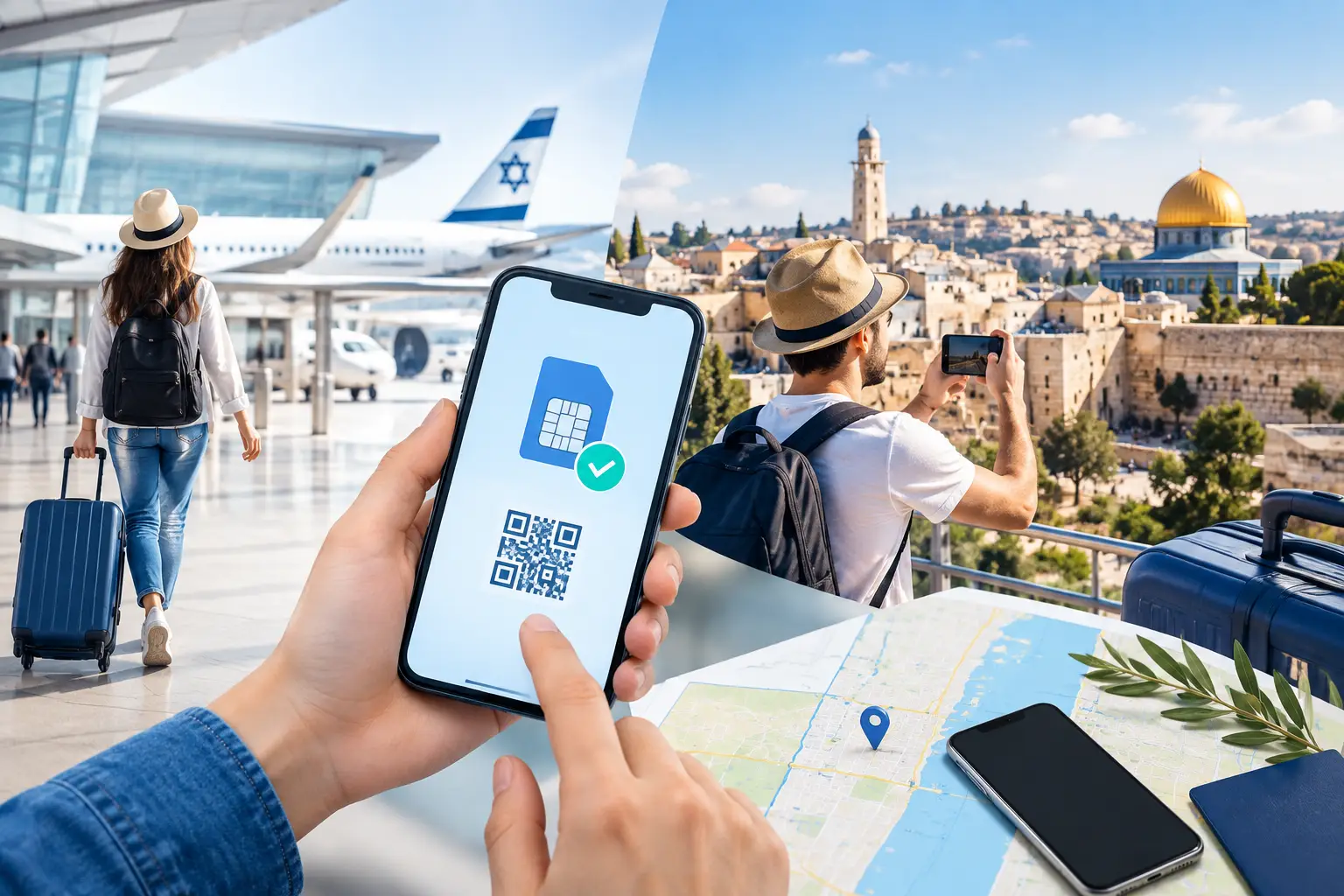
A prepaid Israel eSIM replaces uncertainty with a known upfront cost. You choose a data allowance and validity period before your trip, pay once, and activate digitally with a QR code on an unlocked, compatible device. There is no physical card to collect after a long flight and no need to search for a mobile shop on arrival.
The key benefit is separation. Your travel data runs on the prepaid local plan, while your home line can remain available for essential calls or two-factor authentication if your phone supports dual SIM use. You can set the Israel eSIM as the line for cellular data and keep your regular number active without allowing it to roam for data.
Plans that include a real Israeli +972 number add another useful layer. You can make local calls, receive local calls, and use SMS allowances when they are included with your selected plan. This is practical for hotel coordination, restaurant reservations, local service providers, and relatives or colleagues in Israel.
eSIM Israel is designed for short-term visitors who want prepaid data, local features, and activation arranged before arrival. Depending on the selected plan, service may use leading Israeli mobile networks and support hotspot sharing, so you can connect a laptop or another device when you need to work on the move.
How Much Data Should You Choose?
The right allowance depends on your habits, not just the length of your stay. A traveler who uses Wi-Fi at hotels, sends messages, checks maps, and occasionally browses may need far less data than someone who posts video daily, works remotely, or streams entertainment between destinations.
For light use, focus on messaging, maps, email, ride apps, and web searches. For moderate use, add social media, frequent photo sharing, and hotspot sessions. Heavy users should plan for video meetings, large uploads, streaming, and multiple connected devices. Downloading offline maps, music, language packs, and travel documents before departure can reduce mobile data use in every category.
If you are traveling with family, avoid assuming one phone can comfortably carry everyone. Hotspot use is convenient, but it can consume data quickly when several devices sync photos, update apps, or stream video. A separate prepaid plan for each active user often provides better control.
Set Up Your Phone Before Arrival
First, confirm that your phone is carrier-unlocked and supports eSIM. Most newer flagship phones do, but compatibility varies by model, region, and carrier. An unlocked phone is essential because a carrier-locked device may reject another mobile plan.
Install the eSIM while you have reliable Wi-Fi, preferably before you leave home. Keep the QR code and activation details accessible offline, such as in a saved file or printed copy. During setup, label the lines clearly - for example, “Home” and “Israel Data” - so it is easy to select the right settings later.
Once installed, set the Israel eSIM as your cellular data line. Disable data roaming for your home line, and only enable it for the travel eSIM if the activation instructions require it. Turn off cellular data switching if your device has that option, since it can cause the phone to fall back to your home line when the data connection changes.
When you land, give the phone a few minutes to register on an available local network. Service quality can vary by location, building materials, network conditions, and your device. In remote areas, underground spaces, elevators, shelters, or restricted security zones, reception may be limited regardless of which service you use.
Keep Your Home Number Without Paying for Data Roaming
Many travelers need their usual number for bank codes, airline alerts, or messages from home. Dual-SIM settings let you keep that line active while using the Israeli eSIM for data. This setup is useful, but it requires deliberate settings.
Leave your home line on for calls and SMS only if needed. Set the local eSIM for data. Avoid placing calls from your home line unless you understand the roaming charge, and use Wi-Fi calling only when your carrier confirms how it handles international use. Banks and other services can be unpredictable with verification codes, so test critical access before you depart.
A phone plan should make the trip easier, not become another bill to decode after you return. Choose the option that matches your stay, install it before travel, and keep your data settings under control from the moment you land.
eSIM Israel Team
Last updated