
In This Article
Your phone should work before you leave Ben Gurion Airport, not after you find a SIM shop or connect to uncertain public Wi-Fi. This Israeli eSIM coverage guide explains what travelers can realistically expect from mobile service across Israel, where signal is typically strongest, and how to choose a prepaid plan that fits the way you travel.
For most visitors, coverage is strong in the places that matter most: airports, cities, hotels, highways, business districts, and major tourist destinations. The details still matter. Network availability can vary by your exact location, your phone, local congestion, and the network assigned to your selected plan.
Where Israeli eSIM coverage is strongest
Israel has extensive mobile infrastructure for its size. Travelers generally find reliable 4G service in populated areas, with 5G available in many locations on supported devices and networks. A prepaid eSIM gives you access to local mobile service without relying on expensive international roaming or hunting for a physical SIM after landing.
Tel Aviv and central Israel
Tel Aviv, Jaffa, Herzliya, Netanya, Ramat Gan, and the wider central region are among the easiest places to stay connected. Mobile data is typically dependable for maps, ride apps, messaging, video calls, restaurant reservations, and remote work on the move.
This is also where high-speed 5G may be available most often, depending on your device and the local network. Treat 5G as a useful bonus rather than a requirement. A strong 4G connection is more than capable of handling the travel essentials.
Jerusalem and nearby destinations
Jerusalem has broad mobile coverage throughout central neighborhoods, hotel areas, major attractions, and commercial districts. Your eSIM can make daily logistics simpler when you need directions, digital tickets, messaging, or a quick call to a local business.
The city’s hills, dense stone buildings, and indoor spaces can affect signal from one street to the next. This is normal in any historic, built-up city. If your signal drops indoors, moving nearer a window or stepping outside often helps.
Haifa, the Galilee, and the north
Haifa and other major northern cities usually offer solid connectivity. Coverage is also commonly available around well-traveled areas of the Galilee, including major roads, towns, hotels, and popular visitor sites.
When you travel farther into rural areas, hills and valleys can create local variation. Downloading offline map areas before a long day of driving is a smart backup, even when you expect to have data. It saves battery and keeps you oriented if the signal changes on a remote road.
The Dead Sea, Eilat, and southern Israel
Popular destinations in the south, including the Dead Sea hotel zone and Eilat, are served by mobile networks and are generally practical places to use travel apps, share photos, and stay in touch. Service along primary travel routes is also commonly available.
Outside towns and established tourist areas, geography matters more. Desert terrain can mean weaker or inconsistent reception in isolated locations. Do not rely on mobile data as your only safety tool when hiking or driving through remote areas. Tell someone your route, carry water, and download what you need before setting out.
What affects your eSIM signal in Israel
An eSIM does not create coverage on its own. It connects your compatible phone to a local mobile network. That means your experience depends on both the network and the conditions around you at that moment.
Your phone model matters first. A recent, unlocked, eSIM-compatible device will usually support the local 4G and 5G bands needed for service. If your phone is locked to a carrier at home, it may not accept a travel eSIM even if it has eSIM capability. Confirm both points before purchase.
Local conditions matter too. Signal can be weaker in underground spaces, elevators, thick-walled buildings, shelters, and certain restricted security areas. Crowded events can also slow data temporarily because many people are using the same nearby network resources. These are short-term conditions, not necessarily a problem with your plan.
Finally, plans may be routed through different Israeli mobile providers. eSIM Israel plans may use service from leading local networks and prepaid providers, including Cellcom, Pelephone, HOT Mobile, Partner, wecom, 012 Mobile, 019 Mobile, and Rami Levy, depending on the plan selected. Coverage experience can therefore differ slightly between plans and locations.
How to choose coverage for your itinerary
Start with where you will actually spend time. A visitor staying in Tel Aviv and Jerusalem for a week has different needs from someone driving from Haifa to the Golan Heights, then continuing to the Dead Sea and Eilat.
For a city-focused trip, prioritize enough high-speed data for navigation, rides, social media, video calling, and hotel Wi-Fi backup. If you are working while traveling, estimate your daily use more carefully. Video meetings, cloud uploads, and hotspot use can consume data quickly.
For a road trip, data allowance and hotspot support may be more valuable than chasing the highest possible speeds. A plan that lets you connect a laptop or another device can be useful during transit, at accommodations with weak Wi-Fi, or when coordinating with family.
A real Israeli +972 number is worth considering if you expect to call local restaurants, drivers, hotels, clinics, or businesses. It can also be practical for receiving local calls and SMS messages. Data-only service may be enough for travelers who communicate entirely through WhatsApp, iMessage, email, and app-based calling, but a local number removes friction in situations where a local contact method helps.
Set up your eSIM before you fly
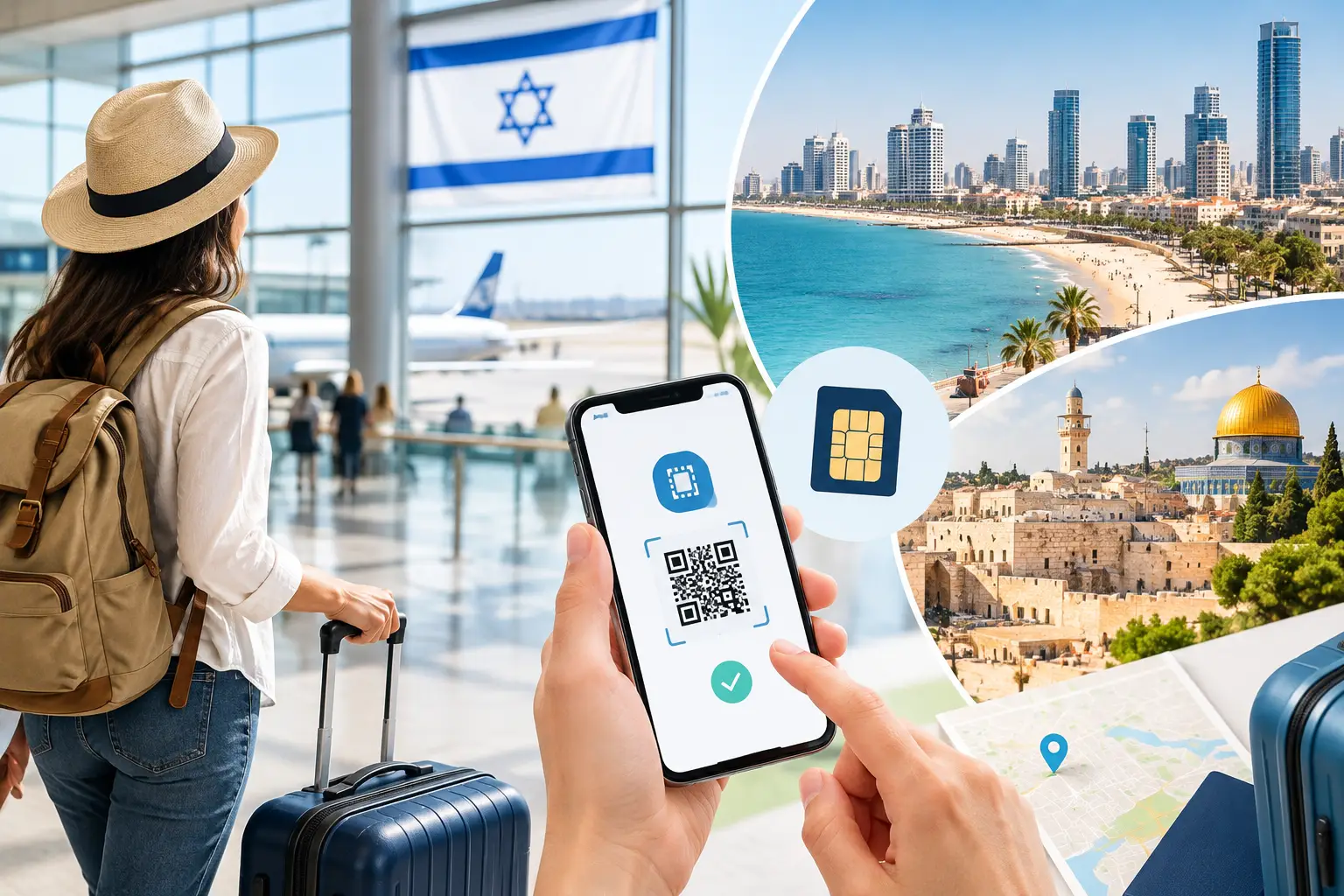
The easiest time to install an eSIM is before departure, while you still have dependable Wi-Fi and time to check each setting. After purchase, you typically receive a QR code and activation instructions. Scan the code from your phone’s cellular settings, label the new line clearly, and keep your regular home line available if you need it for verification messages.
Do not turn off your primary line blindly. First decide how you want calls, messages, and mobile data handled during the trip. Most travelers set the Israeli eSIM as their mobile data line and disable data roaming on their home line. This helps prevent unexpected roaming charges from your home carrier.
When you land, turn on the eSIM line and give it a few minutes to register on the local network. If data does not begin immediately, confirm that mobile data is assigned to the eSIM, data roaming is enabled for that travel eSIM if the installation instructions require it, and airplane mode has been turned off. Restarting the phone can also refresh the network connection.
Get more from your mobile data
Mobile coverage is most useful when your phone is prepared to use it efficiently. Download maps for the areas you plan to visit, save hotel addresses in more than one app, and keep key booking details accessible offline. These small steps help when you are in transit or have only a brief signal interruption.
If your plan includes hotspot support, use it thoughtfully. Hotspotting is excellent for sending an urgent work file or connecting a tablet, but streaming on several devices can use an allowance much faster than expected. Check your plan details before sharing data with travel companions.
Keep an eye on battery life as well. Searching for service in rural terrain uses more power, and navigation apps can drain a phone quickly. A compact power bank is one of the simplest travel backups you can pack.
A practical coverage checklist before arrival
Before your flight, confirm that your phone is unlocked and eSIM-compatible, choose a data allowance based on your itinerary, and install the eSIM while connected to Wi-Fi. If local calls or SMS may help during your trip, select a plan with a real Israeli number and the included allowances you need.
Then arrive ready to use maps, message family, call local contacts, and get on with your plans. Strong mobile service cannot eliminate every coverage variation, especially in remote or heavily built-up locations. It can, however, give you a dependable local connection for the moments travelers use most - from the airport pickup to the final day of your trip.
eSIM Israel Team
Last updated